Regarding the Chak'sa and the Great One

I would like to dedicate this post to one of dark sun’s monumental grey areas: The Great One. Not grey area as in moral grey or how people like it, but what it actually means. Who exactly was the kreen great one? Was he one or two beings? How powerful was/were he/they? What was/were his/their role in kreen history?

One version I heard said that there were two beings, a great kreen lord and an avangion, who ruled a great community of humans and kreen. It says that the mysterious Chak’sa was a landing pad of sorts for the Avangion, and that it produces a number of lights when touched in a specific way. The community was said to have been destroyed during either the preserver jihad or the cleansing wars. That doesn’t make sense, however, because the first metamorphosis spell, the dragon metamorphosis spell, was supposed to have been developed by Borys after both events, and the avangion metamorphosis spell was developed by Oronis even later. Yet it is stated that the kreen view all avangions as aspects of the Great One. So who was that achronistic avangion, and how did he get there?

Are there any other theories that fit the data available?

Also, whatever the purpose the Chak’sa had at one time, it is different now. I almost see it as a power conjunction of sorts, specifically a psionic one relating to the Chat’tho, granting some powers to Thri-Kreen, Tohr-Kreen, Zik-Chil, Zik-Trin’ta, and Zik-Trin’ak as a psionic location. If anyone has any ideas for what it would do now, please tell me. Otherwise, I will post my best guess in a few days.

2 Likes

Well, this seems like just another mistake in the older material, but i’ll indulge you for discussion’s sake.
we already knows that time travel is possible on athas, at least to some degree, exemplifies by the mysterious visitor from the future that warend the king of saragar. But if that the case it just raises more questions- why would it physically travel back to such a time and place? A single avagion cannot hope to stop the cleansing wars after they were already at motion. To me at least it doesnt make sense.
But what if he didnt travel physically? What if, just like the mysterious visitor to marinta, he just sent visions to the thri kreen?
Just my two cents

1 Like

Is it possible we’re looking at the problem backwards?

There’s certainly an inconsistency between the existence of the Great One before the Preserver Jihad / Cleansing Wars and the development of the avangion metamorphosis spell by Oronis.

But…I believe that all the origional sources IMPLY that Oronis was the first to invent the avangion metamorphosis spell, and SAY that he had to come up with it from scratch / by changing the dragon metamorphosis spell.

What if the avangion metamorphosis spell was ORIGINALLY created by the Great One before the Preserver Jihad / Cleansing Wars and Oronis simply never had heard about it? Then, he’d have to invent it from scratch himself.

Rajaat himself suggested to his champions that there something like the dragon metamorphosis spell out there to be discovered, which is how they thought to follow that line of research in the 1st place. what if Rajaat was referring to the Great One’s transformation? Being an avangion would certainly come in handy if you were trying to slow the proliferation of defilers in the late Green Age…

2 Likes

That has fascinating implications. It would mean that, perhaps, Oronis discovered the spell in his travels. Perhaps this might have been the catalyst for his change of heart, knowing there was another way.

1 Like

Rajaat himself suggested to his champions that there something like the dragon metamorphosis spell out there to be discovered, which is how they thought to follow that line of research in the 1st place.

I would say that Rajaat started their metamorphosis himself. I know that on the Athas.org 3E documents it states that champions and dragons are different things, but I think that they are the same thing. Confusion about this was introduced in the revised box set.

1 Like

No, the idea was already introduced by then. The Expanded & Revised setting was released in 1995.

In Dragon Kings (released in 1992), with the Dragon progression (useless if you had to be a SK or Champion to use it) and in Black Flames (released in 1993) where the is a Dragon that is clearly NOT one of the Champions / SK’s.

I’d say the Expanded & Revised setting CLARIFIED the difference, not introduced confusion into it.

1 Like

No, that’s not right. Rajaat created the dragons, and he gave them a title, “champion”. Others also became dragons through their own efforts, like Farcluun from Black Flames. If you look at Dragon Kings it is clear that the Sorcerer Kings are dragons and nothing else.

The revised setting introduced confusion through negligence because Slaviksek messed up the lore.

Sorry, but the Dragon Kings accessory makes no mention of dragons being able to grant spells to worshippers. The Sorcerer-kings were much more than just dragons.

1 Like

The Sorcerer-King are Champions and can grant spells because they each were granted a Living Vortice.

“Through the use of the Dark Lens, Borys rewards the remaining Champions by beginning their transformations into sorcerer-kings. This process links each of them to living vortices, which allows them to grant their followers clerical spells.”

As far as I’ve always understood all the Sorcerer-Kings are at some stage of the Dragon Metamorphosis.

So, all the Sorcerer-Kings/Champions are Dragons (at some stage or another, except Oronis), but not all Dragons are Sorcerer-Kings/Champions.

That is why (i think) Tithian freed Rajaat, he wanted a Living Vortice so he would basically be a “god”. Whether he was aiming for Metamorphosis also, I’m not sure as i haven’t read the books. Correct me if I’m wrong about Tithian.

Just my two ceramic bits.

P.S. Regarding the Great One, has always been a mystery for me too. I have every Setting and Adventure book (in my knowledge) on Dark Sun, including from Athas.org and have never seen much on it. Besides being a dual entity (or something) and being revered by the Kreen, i know zilch about it. I would love to see if anyone has any other materials mentioning it.

3 Likes

Per the original 2e rules, the SMs were all simply dragons. Being a champion was just a title. The fact that they could grant spells was because they were linked to the living vortices, which happened as a by-product of them all becoming 21st level dragons at once. The book explicitly says that the reason new dragons and avangions WON’T be able to grant spells is that the LVs are “now” all extinct. Only those attached to the SMs exist.

However.

Two important points:

  1. Dregoth Ascending and Secrets of the Dead Lands establish in explicit terms that Living Vortices not only can survive beyond their “host” SM dying, but can then re-attach to another “host,” allowing said host to then grant spells to his/her/its own “templars.”

  2. Lynn Abbey actually promoted the idea that being a champion was more than a title, linking it to the dragon metamorphosis (at least with hamanu) and some kind of life-shaping transformation on Rajaat’s part in general.

As for the chak’sa: I think we’ll never really know. The best explanation I’ve heard was that an Avangion predated everything. Whether because Keltis DIDN’T actually create the spell and simply found/recovered it, or because time travel was somehow involved. The Simon Hawke novels aren’t well-regarded, but remember one of the major plot points was that The Wanderer (yes, THAT one) was actually a proto-Avangion who ultimately escaped into the past using time travel magic in Bodach.

Actually, I don’t remember if he actually went into the past for good, or if it was more a general hiding in the past type thing.

But even though most don’t seem to like those books (myself included, for the most part), The Wanderer as a time-traveling avangion may have been related to / hold common origin for the Chak’sa in the past plot thread.

5 Likes

I’ve always assumed The Great One was meant to be a PC when he gets to high-level messianic status. The story would write itself.

1 Like

What if there was an Avangion, just not a transformed one? Dragons are a common enough thing on other worlds, who is to say there couldn’t have been Avangions on Athas during the green age.

I love time travel… the Preserver Metamorphosis X spell has you go into a glass box… then you disappear for up to 2 years. If the glass box is broken, you don’t come back. I ran a “quick” adventure where Oronis used the PCs as guards during his final metamorphosis. The PCs ran characters both in the present and in the past. Oronis was the “Great One”. He was both the creator of the spell (based off the Dragon version) and the ancient one he used as inspiration for the form he eventually took (in my campaigns the spell allows more variety, dragons with different wing types such as feathered and butterfly or bat like depending on Preserver or Defiler or more wispy types like the traditional avangion).

1 Like

who’s to say all avabgions look one way or another? the preserver metanorphosis spell is an epic spell, making it inherently morphic. theoretically, you could have an avangion who looks like a dragon, or visa versa.

4 Likes

“When the age of the Great One is come, make ye a joyous light.”" -an inscription on the dais to the Chak’sa, written in the a lost dialect of the thri-kreen

(cited from page 80 of The Road of Fire adventure book, from the Dragon’s Crown sage)

Professor Zik-Chil is most apt: the subject of the Great One is perhaps one of Athas’ greatest mysteries. Dependent upon interpretation, the Great One could be one of the most fundamental personages in Athasian history, and its origins, life, and eventual fate could be instrumental to the history of the world.

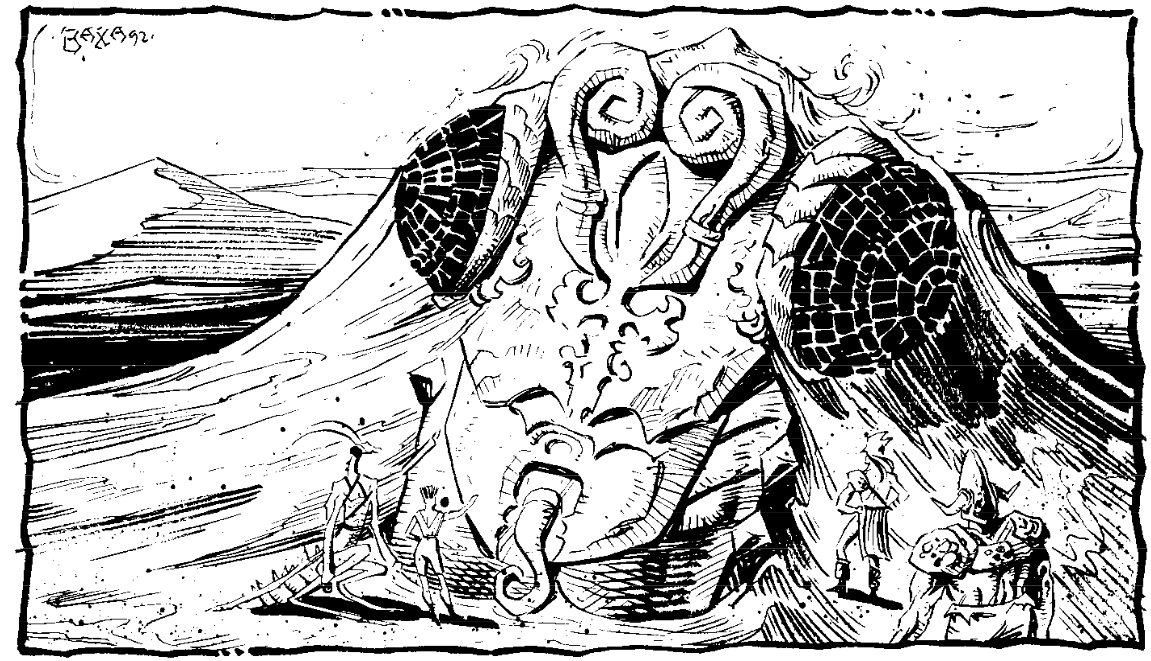
We know precious little. The Great One is first referenced in the Dragon’s Crown mega-adventure, in the above citation. In my opinion, Dragon’s Crown is one of the crowning achievements of early Dark Sun, and I much applaud Richard Baker III’s efforts here. I suspect Baker, one of the original core designers of Dark Sun, is the conceptual source of the “Great One,” or else he was the one to put his official stamp on it. It would be easiest and best to ask him.

As we all know, the Great One received more detailed and thoughtful treatment in the Thri-Kreen of Athas supplement by Tim Beach and Dori Hein. I do much admire this work as well, and for many reasons, but I would note that their conceptual adornments to the Great One were secondary, and an acretion to the mystery of Baker’s original concept. Still, Beach and Hein’s comments on the Great One, or Chak’sa as they have it, have fascinated us. For Beach and Hein, they are definitive in their explanation:

“…the Head is a representation of an actual great kreen who lived thousands of years ago; this kreen also worked with an avangion, and the two “memories” have become inseparable over thousands of years.” -T-KoA, p. 60

There is however an issue with this. In Baker’s earlier and again original description of the Great One statue, we have this detail which is missing from Beach and Hein, despite their extensive treatment of the Chak’sa site:

“But there is one surprise: the rear of the head is carved into a human face. The image is that of a bald man, with golden eyes. The face looks uncannily like Korgunard.” (p. 80, RoF, DC)

Beach and Hein completely ignore this detail, as it contradicts their revamped version of the Chak’sa sitr. This indicates that the statue is not a monument to an actual living ruler, but perhaps is indicative of a prophecied ruler, Korgunard, the future lower level avangion, who was foreseen as rising to 30th level one day as the “Great One.” The human face indicates the backfacing human origins of that which would appear to be kreen-like in the future.

In Dragon Crown, we are obviously meant to compare the statue to the fully metamorphosed 30th level avangion, and see the comparison. Now how and why a thri-kreen prophet would have foreseen the avangion, or much less Korgunard, is a matter of speculation.

I would argue that if you are of an originalist leaning, the Chak’sa was originally a statue of something prophecied to come, and not an actual being from that time. It was Beach and Hein who ignored the humanish face of Korgunard in the Chak’sa, and it is they who were the origin of the concepted of the paired avangion and kreen ruler from thousands of years in the past.

I would offer that the original statue, with the glittering eyes and prophecy of the Great One to come, is a statue made of something like religious devotion, created as a manifestation of belief for a golden age to come.

I will conclude that for Baker, Dark Sun remains a cruel setting. Though Korgunard was thoughtfully developed over multiple adventures, and he is a manifestation of heroism and hope for a world restored, he is nonetheless cruelly betrayed and slain in Dragon Crown. The great saga of Korgunard comes to an end, and if the Chak’sa was a prophecy of the Great One to come, complete with a humanoid face resembling Korgunard specifically, then Korgunard’s death is a prophecy denied. Though strong, the cords of fate are not invincible, and the cruelty of Athas has cut Korgunard’s fate short. Baker writes that the Great One is denied, the coming of the Avangion is denied, and the world remains fallen and dark, though defiant heroes yet fight on to fates unknown.
1 Like

While I don’t disagree with your analysis, I’d say that the future isn’t set… Korngunard didn’t come back, but another avaignon might, especially knowing the history of the Great One.

1 Like

Indeed, it could be argued the spirit of the prophecy remains true. But it is clear from Dragon’s Crown that Korgunard’s specific face was depicted on the back of the Chak’sa statue. That is clearly what is meant. So the specific prophecy of Korgunard rising to be the Great One is denied. The original prophet, whoever he was, saw Korgunard’s face in the depths of time, and though his prophecy nearly came to pass, it nonetheless ultimately failed.

Yeah, i also don’t necessarily agree with these conclusions.

Kreen face on front and human face on the back is LITERALLY just a different point of view from kreen on the left and human on the right.

Also, "The face looks uncannily like Korgunard.” could in fact be referring to the features common to an early-stage avangion, rather than specifically Korgunard himself. Consider that if a person only ever saw one example of a particular ethnicity, they’d probably describe others of that ethnicity as looking like that first individual (i.e., all elves look like a lot like your only elf acquaintance, if you’re a sheltered dwarf).

2 Likes

All this aside, despite the clear original meaning, I might actually accept theThri-Kreen of Athas version. It may suit my campaign. And besides, one problem with what I have argued above is the extremely kreen-like head that is the Chak’sa. It is always drawn very buglike, and not as the serene and mouthless alien moth-like head of a full avangion.

Perhaps there was a great Kreen of ages past, one which paired with a long lost junior avangion. Perhaps it was the first avangion.

…My dissatisfaction with 2nd box material is somewhat well known here, I think. One reason is because I increasingly don’t care for the Oronis concept. I see no way in which Keltis could have gotten out of paying the levy. Borys would have demanded a full Champion pay his share. Even if Kurn withered, Borys would have demanded he raid to pay the annual toll. And a goodly avangion, as Oronis is written, could not be a part of that.

Perhaps the real first avangion was not Keltis, but rather the avangion associate of the kreen Great One. Perhaps this avangion fled Rajaat and Borys for the most remote lands. Fascinating to contemplate anyhow.

1 Like

I’m pretty sure that there was a sizeable gap in time between the last levy placed on the northern cities and Keltis deciding to start switch to good?

1 Like