Ita detailed in the timeline in Lost Cities of the Trembling Plains (I’m mid-game RN, or I’d check myself).
Yeah, the biggest problem I’ve personally ever had with Oronis is whether or not the “Oronis is the 1st avangion” is objectively true or if its true as far as he knows.
If the Great One was a proto-avangion and Oronis just didn’t know about it, then there’s still various complications and timing to address/consider, but it’d resolve the “first avangion” issue.
1 Like
Huh. Exact same year. Daskinor faces off against the Dragon, and Keltis grows a conscience.
1 Like
There were 15 Champions. Borys wouldn’t levy his own city, and Sacha and Wyan were executed before they could start a city. (Unless they had built cities already. Several Champions finished their purges, founded cities, and THEN got the living vortexes.)
So that’s twelve.
54 years later, Dregoth and Giustenal are destroyed. It’s not recorded if anyone picks up the slack.
205 years after that, Sielba and Yaramuke are crushed by Hamanu. Rather than picking up the slack, Hamanu gives the Dragon a good chunk of the loot.
If the disappearance of Kalid-Ma and Kalidnay are in the history of the Cities of the Trembling Plains, I missed it…
Anyway, the Dragon is down to 9k sacrifices. With the loss of Kurn and Eldarish (can’t remember spelling), he’s down to 7k sacrifices. (Even Tithian didn’t refuse him.)
Personally, how close the southern Anattan Coast is, compared to the far north, I think he had just made up the shortfall by a little raiding. It would have kept his army sharp.
1 Like
That assumes the levy was always 1000, though. If the levy started at 500, then climbed as the number of cities dropped off, then there might be less of a drop.
“You idiots are going to destroy two cities? Then give me more slaves! Or do you WANT Rajaat to come back?”
3 Likes
The LCotTP Timeline isn’t meant to be comprehensive, it just covers stuff that’s important to thr Forgotten North. (Though that probably means we should push that info to the comprehensive timeline on the website…  )
)
Anyway, from the v8 Rules, pg 195:
“Year of King’s Contemplation (Free Year –1,228) In an effort to increase his power, Kalid-Ma attempts to further his dragon metamorphosis to a power near that of Borys of Ebe. The attempt is successful, but his mind is destroyed in the process. The dragon that was Kalid-Ma destroys his city of Kalidnay and begins to move into the rest of the Tyr region. The creature is soon slain by the combined efforts of Borys of Ebe, Kalak of Tyr, and Hamanu of Urik. With the loss of Kalidnay, the levy to keep Rajaat imprisoned becomes a firm 1,000 slaves from the seven remaining sorcerer-kings.”
1 Like
“Do you WANT Rajaat? Because this is how you get Rajaat!” 
2 Likes
Seriously Adam. The former Champions would be terrified of their erstwhile master’s return. Fates worse then death could await them. I have thought that such terrible fates alone kept them motivated through the interminable years, giving more meaning to their endless lives…
In Obsidian Oracle, Borys doubles the levy on Balic because Tyr failed to pay just just one year, resulting in major consequences for Balic.
It’s not just Borys…they all would have demanded their peers pay, and pay in full. And I presume Borys was obliged to levy payment from every surviving city capable of doing so… from across the world. Elsewise, why would the Champions accept their cities be levied, when far off cities might be spared. Indeed, the Dragon likely raided throughout the world much of the year, and increasingly, as the world dwindled. By the end of the Age of the Sorcerer-Kings, levies that might have been a few hundred originally had blossomed to a thousand a year.
This is why I imagine much of the world beyond the Tablelands (both the Tyr Region and Anatta) are all but cityless and thoroughly dessicated. The last major populated region are the Tablelands, and by the Prism Pentad even those cities are teetering on disaster.
1 Like
I can agree with this AND giggle about “This is how you get ants!” jokes.
Interesting and logical, but (and YMMV) the Anattan Gazetteer establishes that the Dragon largely pulled material resources from the Anattan to maintain his city and protect Rajaat’s prison, and lives from the Tablelands/Tyr Region to maintain the prison itself.
1 Like
Arguably, the Tyr Region is Borys’s people-ranch, and the SKs are his ranch hands.
As for devastating the whole world, though … For some reason Borys doesn’t seem to have harvested the Kreen Empire, even though you’d think they would have been far better prison fuel, since they grow up so much faster than humans, elves, dwarves etc.
–
I thought the two faces on the Chak’sa, kreen and human, were because it commemorated both a kreen leader and a human/avangion leader of that nation?
2 Likes
Right, that was my understanding (but its not a bit of lore i pay super close attention to…)
One of the athas.org files lists all the types of undead (I think the templates?) and gives a sample character for each.
One of the sample characters was a soldier that guarded the city of the avangion and the kreen.
Just to throw another wrinkle into the discussion, in that tale, the avangion (if my memory is correct) was a halfling.
2 Likes
That nation is a really interesting idea, to me. Apparently it was destroyed by “the sorcerer-kings and the Dragon”. I can read that two ways, at face value it sounds like it was a relatively ‘recent’ (during the Brown Age) event.
But it could also mean “destroyed by the Champions who were later to become the sorcerer-kings and the Dragon”… which would make it a Green Age/Time of Magic nation.
1 Like
I regard it as part of the Preserver purge, impersonally. (sic)
1 Like
I found some more interesting factoids from Dragon’s Crown… patient readings for details are oft helpful. A full review of Dragon’s Crown (which I have not done but mean to) would be helpful, but regarding the Chak’sa, the Great One, and the Nation of Kreen & Man:
Walking across the scrub lands you pass between
two buttes that rise up perhaps 100 feet on either side.
Ahead you see a line of pillars, spaced about 50 feet
apart, flanking what remains of a flagstone road. In
places, the road has retained its original width of
about 250 feet, but most of the road has crumbled
away or been buried by blowing earth and sand.
Moving closer, you can see that the pillars are
carved from white stone, and are perhaps 60 feet tall
and fluted. The top of each has been carved as a
head. Every other pillar ends in a thri-kreen head,
while the others are topped by the carved heads of
male and female humans. Each appears to be a por-
trait, since no two are alike. Some heads are weath-
ered beyond recognition, others well-defined. A few
pillars have fallen and shattered into rubble.
(Road of Fire Adventure Book, p. 82)
Indeed, in the picture below, we can see a sketch of these human- and kreen-headed pillars lining the remnants of a massive 250 ft. wide flagstone road… the very road that approaches the Chak’sa and the Circle (the massive burial and hatching ground of the thri-kreen).
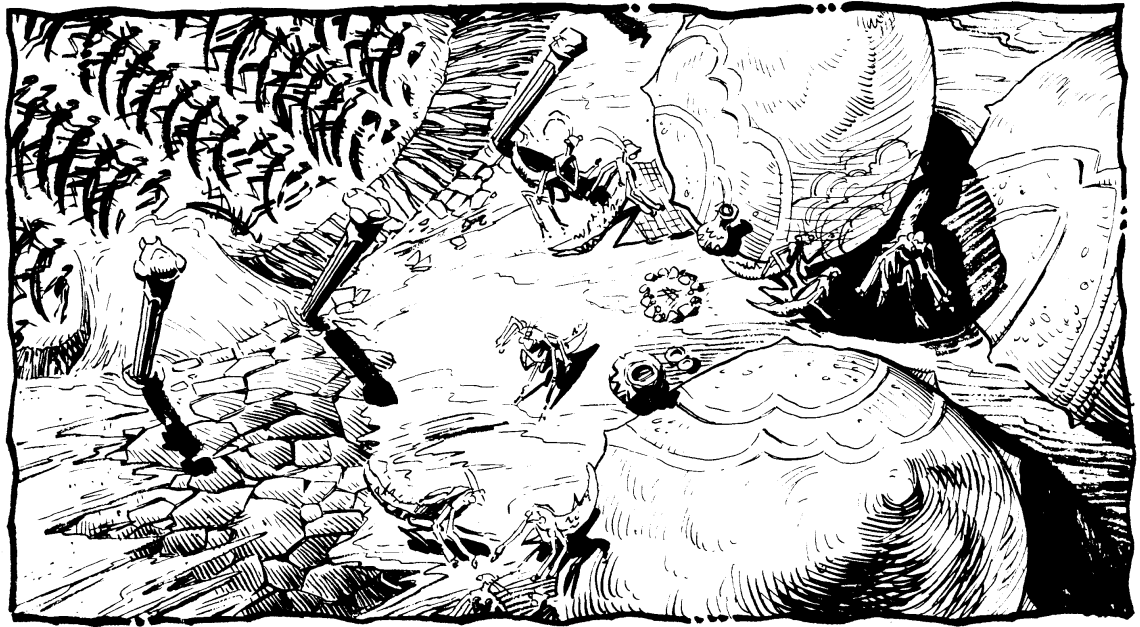
Clearly, this great road and the pillars lining it to one side are relics of a kreen and human nation. The pillars with the unique heads remind me of the wooden busts Greeks would make of olympian victors… they would only accrue after the long march of years. The “Circle”, the great bowl in which all thri-kreen ideally are buried and hatch from, to which the enormous flagstone road seems to lead, seems to be of supernatural origin, and likewise seems a relic of this Nation of Kreen and Man.
With this evidence, I correct my above assertions, and now argue that the Thri-Kreen of Athas authors were correct in that there were at least one pair of great kreen and human (avangion) rulers over a somehow unified nation in antiquity. Just how far back, I cannot say for certain. I would speculate that this nation’s heyday must have been before the Cleansing Wars, as it would presumably have been an abomination in the sight of Rajaat. If one of its rulers truly was an avangion, this would suggest such a Nation would have thrived nearer to the Dawn of Magic, in my mind placing this nascent avangion before the first Champion was created beneath the Dark Lens at the Pristine Tower.
I would submit that this avangion–surely lower level give the humanoid face with golden eyes on the backside of the Chak-sa–was probably the long-time co-ruler of the nation, alongside an apparently mighty and presumably long-lived kreen. Further, so early was this avangion that it must have been one of Rajaat’s earliest students, and perhaps one that eschewed Rajaat once he gained insight into the First Sorcerer’s twisted nature and true intents. It might have even been before Rajaat’s empowerment at Kano Swamp, which presumably would have severed ties with any preserver-aligned former student of Rajaat for all time.
If all this is so, it would follow that this avangion, the first wizardly advanced being, would have been a threat and challenge to Rajaat’s plans. Given the prophecy of the Chak’sa, it might follow that this nascent avangion, still junior in level, may have left its nation, abandoning it rather than dooming its destruction, against the power of Rajaat and his new Champions. Perhaps the avangion did this after losing some great battle or war, or perhaps its foresight caused it to retreat to distant lands before such violence. I posit this, because that would explain the promise preserved on the dais at the Chak’sa, that the “Great One” would one day return. The nascent avangion was not yet the “Great One” he foresaw he might become, so it would make sense to promise the nation he was leaving that a “Great One” would indeed one day return.
This at least is one explanation, if we ignore the seemingly clear messaging from Baker that Korgunard’s face is the one on the backside of the Chak’sa. Perhaps, as some of you have said, it is of a face that most any junior-leveled avangion might appear as. Perhaps it was the face of the very first avangion, even if only 22nd-23rd level or so.
Anyhow, a fascinting possibility, given details from Dragon’s Crown. I will search for further clues to give us more such insights.
1 Like
Sure, you’re talking about Terrors of the Dead Lands and Nevalaeg the elf raaig:
“And such wondrous beings! There were humans there, to be sure, but also many gangly insect-men, kreen they called themselves, tall and sharp-edged with nipping claws. Hidden in forbidden enclosures halfling miracle-workers closeted themselves. Over all ruled two kings, one a winged halfling and the other the greatest kreen Nevalaeg could imagine. Both were mindbenders beyond peer, and together they contrived to grant spells to those that served them most directly.”
1 Like
Something that I ponder is, WAS the great one what we now know as an avangion? It was so long ago, we only have legends (which Oronis may or may not have found?), we don’t know what it was.
It LOOKS like an early stage avangion. But what if that was achieved by a different means than Oronis discovered? Maybe it was a preserver/druid, for instance. Or it bonded with life shaped creatures. Not an advanced being, but still memorable.
Anyway, love the site because it has one of my favorite magic items, the everfull pouch (which produces various plants, and a limited supply of trees of life).
1 Like
As has been argued elsewhere, for the fuel of Rajaat’s prison, it seems that only humanoid souls had the necessary power. This must be the case, or else the sorcerer-kings would have turned to sacrificing herds of great beasts to provide the necessary Hit Dice requirements to energize the Prison. The kreen empire, being monsters, perhaps are not of the required soul-power. Perhaps it is because the hearken from a time before the Green Age. Perhaps it is because they have spirits that seemingly may reincarnate, and do not have souls. Whatever the case, kreen must in some way be unacceptable for use in powering the Prison, or otherwise the logic of the levy breaks down.
Given a century of not providing life energy to the prison and it still was just in the process of breaking, I suppose it can be assumed they tried it for a dozen years or so, noticed the prison weakening, and went back to the old method.
1 Like