So 22,000 square miles at 3,000 feet depth would hold 13.8 quadrillion gallons of water. If we treat this as a receptacle than after 4 months with the rainfall described above it would be about 2.7% full. That’s an (average) of nearly 80 feet of water across the valley. I guess the elevation of the entire island is quite uneven and so in some places it’d be much deeper and most hills and such would still be above the water. That’s assuming there’s no aquifers as well. Of course lots of that water would seep into the silt instead etc, but it at least gives you some back-of-envelope numbers to think about.
It has been too long since I have read the fiction, I forgot about that. Grey Death as a condition always struck a chord for me, it has heavily shaped my views on silt.
I asked chatgpt for some calculations:
Given:
- Rainfall rate = 1 inch/hour
- Magma volume = 1 cubic foot = 12″ × 12″ × 12″
- We’re assuming rain falls uniformly over the top surface of the magma (1 square foot area)
- Need to cool and solidify ~50940 kJ (from previous answer)
- Rainwater starts at ~25°C, and all of it is assumed to heat up to 100°C and then vaporize (for maximum efficiency)
If 1 inch/hour of rain falls consistently over a 1-square-foot area of magma, it would take about: 6.9 hours to cool and solidify 1 cubic foot of magma, assuming perfect efficiency and heat transfer. Of course all this would create massive steam.
Lets say the air is 100°F, and steam at 212°F (100°C) is produced from rain hitting magma, the steam will:
- Significantly increase the air temperature — possibly by 20–40°F or more, depending on the amount of steam and air volume
- Increase humidity to 100%
- Create a very dangerous, hot, moist environment
This is a good experiment.
In other words the advent of the cerulean storm would kill most unprotected creatures in the Valley, within days and significant numbers of Ur-Draxans in the city would also die assuming that enchanted walls that protected them from the heat and savage weather of the outside world (pg57 VoDaF) were deactivated when many of the walls were destroyed during the final events of the Prism Pentad book 5.
FWIW, I talk about Ur Draxa in my Next King’s Age article (under the “Beyond Beyond the Prism Pentad” topic). I have not gone into such nerdery, largely because I ran out of fingers to do the math on, but my rough estimate was that, while the Valley itself was flooded over at this point, it wouldn’t be until the 200th King’s Age (another 600 years or so) before even the Mountains of the Sun saw the resulting mud flats, much less the Tyr region.
However, that’s still gonna affect the hydrology of the area; you can’t dump that much water into a system without having an impact, as Doggerland would tell you. Also, while the lava fields MIGHT have affected temperature, a permanent storm system almost definitely will, cooling the area beneath them, as well as putting more vapor into the air.
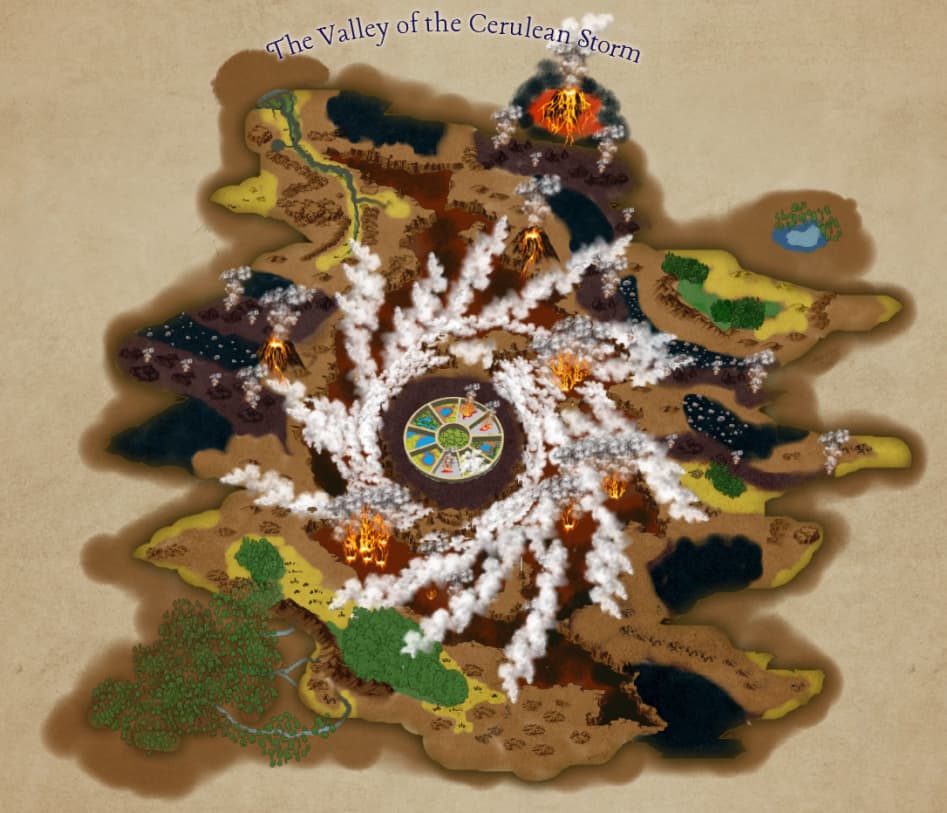
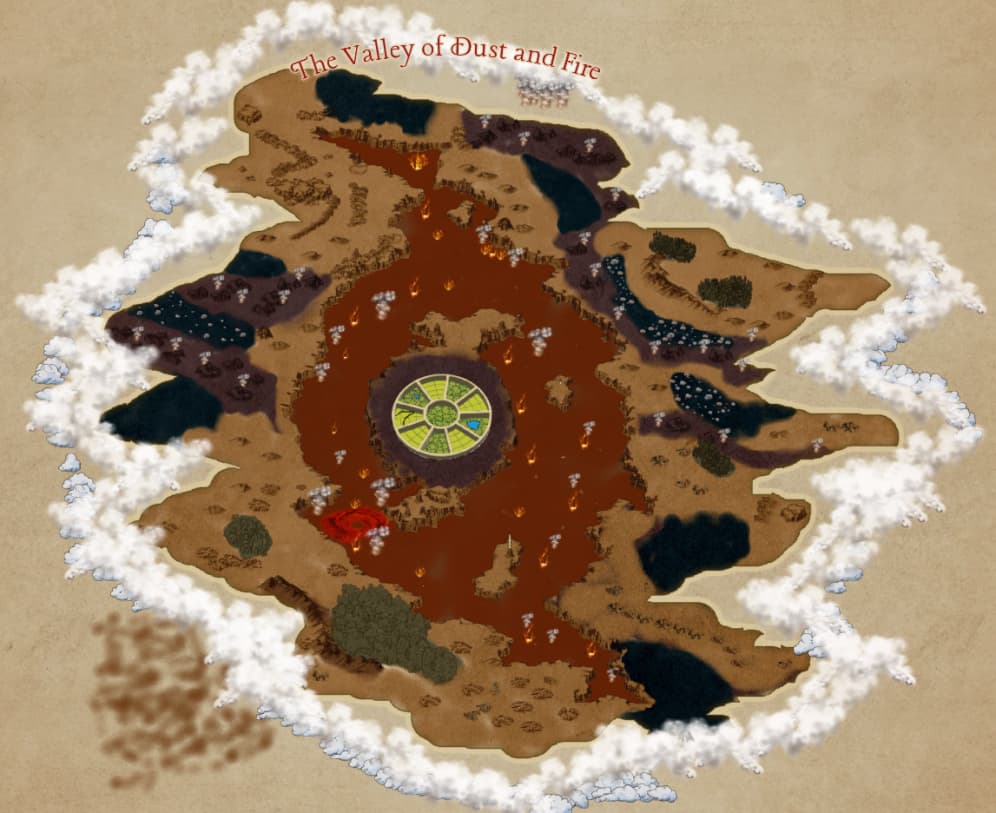
(I don’t have any real mapmaking skills) but I made this conception (years ago) of what happens to the valley in the early months/years after the storm. (My idea is to use this for a FY12 adventure some day). I think enormous mudflats would form before the valley actually begins to flood. I also imagine the storm as basically a hurricane that’s stuck in place but constantly spinning, rather than just a static rain cloud, so I was envisioning a smaller storm (actually) than what I did the math for above. I don’t think the eye of the storm would always be this large but for mapmaking purposes didn’t want to obscure Ur Draxa itself.
7 Likes
I like it! Thanks for sharing Giff.
Well, ultimatly Athas is also full of supernatural forces that shape its environment, we can’t ignore that. How do spirits of the land affect nature? Do air spirits play a role in cooling the planet just enough so it can still support life?
1 Like
That the classical elements support life, while the para-elements seek to eliminate it, seems born out in the text.
That seems too simplistic a pitch - volcanoes impart vital nutrients to the soil, Rain is vital to the growth of plant life, and the Sun is the source of much of the energy on Athas.
Silt does seem pretty antithetical to life though, and the big three paraelements do seem to be on quite the tear right now, flushed with power.
I feel like I’ve seen entries that talk about how Fire would LOVE to burn down the whole world, but has to restrain itself to make sure there’s something to burn tomorrow…
2 Likes
I agree. It may be that the reason the paraelements seem evil is that the balance of nature is out of whack, and the elements are incapable of balancing each other like they use to. In the end there is such a thing as too much of a good thing. Too much sunlight scoures the land of life, too much rain causes floods etc.
1 Like
Exactly. I’m sure Water would be happy to drown the world, given half the chance…
1 Like
I’m not talking about what’s reasonable, just what’s in the text (specifically, Earth, Air, Fire and Water).
EAFW, p. 6
“Regardless, these beings (elemental powers) have deigned to forge a pact of Earth, of Air, of Fire, of Water, with a few selected beings of the Prime Material Plane. Through these few clerics and druids, the elemental powers hope to replenish the decaying planet of Athas and return to the ancient, carefree days of power.”
EAFW, p 36
Paraelemental clerics make the same kinds of pacts as elemental clerics. Unfortunately, however, these clerics delight in the continuing ruination of Athas. The silt seas grow ever larger, cracked earth steadily oozes streams of magma, and cloudless skies offer the harsh, blazing sun an unobstructed assault on the creatures agonizing beneath its heat. Only the paraelement of rain sides with the elementals - it has been too many centuries since cool rains frequently caressed the surface of Athas."
The elemental planes are selfish in their desire for Athas to be healthy… they want more of their element… but they’re still supporting life, while the paraelements (save Rain) are reveling in their expanding place in the world… more silt, more sun, more magma.
Sure but that’s seems to be BECAUSE they currently have an advantage, the fact that rain sides with the elements suggests this as well, I doubt it would do so if Athas was continually bombarded with rainstorms (which sort of beg the question, would the advent of the cerulean storm change that alliance?).
They don’t seek to actively destroy Athas, its a byproduct of their unchecked growth, just like when deer population goes unchecked by natural predators, it leads to environmental destruction. The deers aren’t evil, they just do what they do to survive and thrive, even if the result will ultimately harm them as well.
3 Likes
“Though boys throw stones at frogs in sport, the frogs do not die in sport but in earnest.”
And, complicating that, is that the people acting as the instruments of the para-elements on Athas frequently are evil… the paraelemental powers may not care, and may be distant enough that their lack of care is neutral… but the people actually doing things with them are deciding “You know what would make everything better? If that town took a bath in magma!”
2 Likes
totally agree with you on that, its not necessarily the paraelements themselves that’s evil, but their mortal agents often are
2 Likes
That’s fascinating; it’s got me on another tangent, but that a gateway to Fire is that close to inhabited places makes for interesting story hooks… a temple of fire priests, certainly, but also Magma Priests wanting to usurp the portal and make it one of Magma.
2 Likes
If real world principles apply, we can calculate how much heat a lava sea puts out, roughly.
Going with the estimate of 22,000 square miles above for the Valley of Dust and Fire … that’s about 56,000 square kilometers or 5.6 x 10^10 square meters.
Temperature of lava ~ 1100-1500K … say 1300K
Stefan-Boltzmann constant ~ 5.67 x 10^-8 W⋅m−2⋅K−4
Emissivity of lava ~ 0.8-0.9 … say 0.85
So (5.6 x 10^10) * (1300^4) * 0.85 * (5.67 x 10^-8) … 7.7 x 10^15 watts (7.7 petawatts) That’s about 4.4% of the total energy the Earth receives from the sun (~173 petawatts). That’s pretty significant even globally, and completely overwhelming regionally.
–
A planet like Earth just couldn’t do this … there’s just not nearly enough geothermal energy flux. That exposed lava is constantly radiating heat, so to keep it liquid, that same amount of heat needs to be constantly supplied…
And the Valley of Dust and Fire isn’t the only oversized lava lake on Athas.
So if physics applies at all, then either Athas is vastly geologically different from Earth or the Valley of Dust and Fire is an incursion from the Para-elemental Plane of Magma.
–
As for ash/volcanic aerosols (my understanding is that the primary global cooling effect from volcanic eruptions is due to really fine aerosol particles, not the traditional ash) affecting the global heat balance, that’s absolutely a real effect, but I rather doubt it’s enough here… Athas’ skies seem relatively clear, and I don’t think they would be if there was enough ash to make that much of a difference. Volcanic aerosols make lots of clouds, which cools the world. Athas isn’t a super cloudy Year without a Summer environment.
–
Also, I don’t think the rain from the Cerulean Storm is going to cool that lava sea. By my math, that 7.7 petawatts could boil something like 3 million tons of water per second *.
If it’s a 1 inch/hour rain rate over those 22,000 square miles (56,000 square kilometers)… well, 1 inch = 2.5 cm = 0.025 m, so that’s 1,400,000,000 cubic meters per hour or 388,889 cubic meters per second. Water is basically 1 ton per cubic meter, so the water boiling away is taking about 1/9 of the heat.
1 inch/hour constant rain year round is really extreme, a tenth of that would seem more reasonable. 0.1 inch/hour all day every day is still about twice the rainfall rate of the rainiest place on Earth.
- The heat of vaporization is much larger than the heat needed to raise the water to boiling point, so what temperature the liquid water starts at makes relatively little difference.
3 Likes
The main reason it will never get cooled is that the lava sea has multiple portals to the elemental plane of fire, which is how its kept th we way it is.
What would result from a similar number of portals to Rain or Water being opened in close proximity? Valley of Steam and Flayed Death?
1 Like