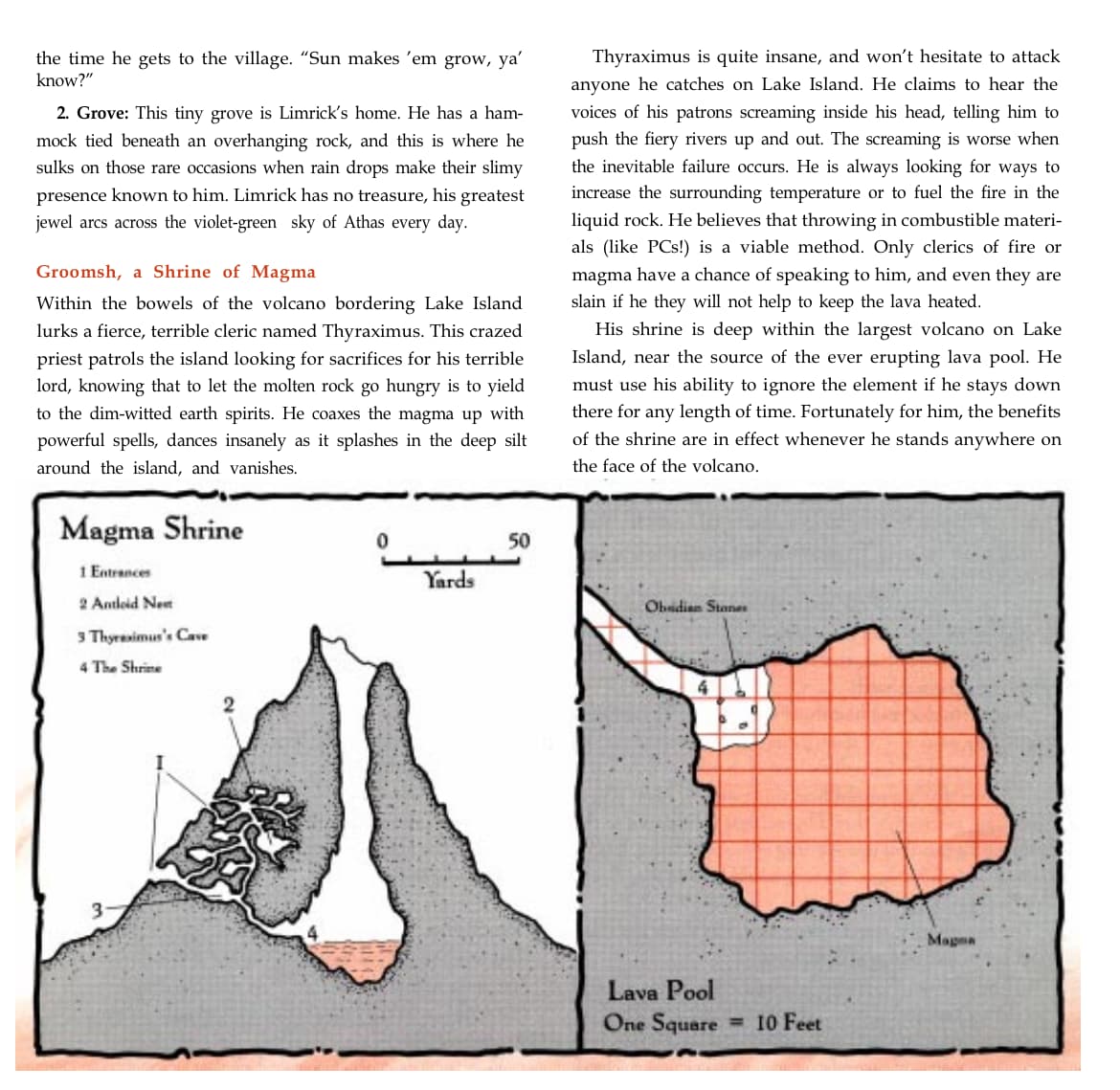
So, Athas has some lava fields, but does anyone recall an actual volcano? My brain keeps going back to the Smoking Crown, but I don’t think it is a volcanic range.
How would the Great Earthquake have impacted a Tyr Region volcano?
So, Athas has some lava fields, but does anyone recall an actual volcano? My brain keeps going back to the Smoking Crown, but I don’t think it is a volcanic range.
How would the Great Earthquake have impacted a Tyr Region volcano?
THERE we are! Thank you.
The Road of Fire in the Sea of Silt is a range of volcanoes. The first and third island are said to be active volcanoes. That’d be a cool touch if they erupted during the earthquake.
Dragon’s Crown Mountain and Lake Island are both said to be dormant volcanoes. Would be cool to imagine them reactivating.
I always assumed Smoking Crown was a volcano, but it appears that’s not made explicit in the Wanderer’s Journal, so maybe it’s not.
I mean, the Smoking Crown Mountain(s) is/are filled with obsidian, so it at least WAS a volcano.
The westernmost and centre islands of the Road of Fire - Dhuurghaz/Furyfire, and Avegdaar/Hellglow - are actively volcanic. The easternmost isle - Morghaz/Dawnfire - is dormant. The volcanic peak at it’s centre has a caldera but it’s solid stone with no suggestion of even a magma chamber underneath it.
The Charvass Peninsula, which is the mainland area closest to the Road is also volcanic, and is named for the volcano which sits above the settlement (also called Charvass) of Moratuc dwarves. These dwarves mine the flanks of Charvass for obsidian. The giants of the Road refer to Charvass volcano as Lazraag, or ‘dwarf-eater’.
You’ve also got the Isle of Ash in the Sea of Silt. It produces copious amounts of ash, as well as occasional eruptions of volcanic gases and dust. Lava eruptions aren’t common however.
Lake Island is an active volcanic island, around 500 years old. Magma trickles from cracks in the side of the volcano, adding to it’s height each year. The summit caldera is filled with a lake of deep blue water, which appears to be heated as blueish steam wreathes the caldera.
Are these book? Do you have a source so I can go check for more context?
Charvass is described in Lost Cities of the Trembling Plains, and is at least mentioned in Dragon’s Crown.
Charvass and the Road of Fire are detailed in the 2nd book of DSE1 Dragons Crown. They were introduced, along with Lake Island and the Isle of Ash in DSR4 Valley of Dust and Fire (both DSE1 and DSR4 are 2nd Edition D&D products. I think you can buy pdfs of both products from drivethrurpg).
(I should note: When I ask for sources, take it academically, not argumentatively; I want to know where it comes from, not fight you about where it comes from)
I guess using the dictionary definition of volcano, which is “a vent or fissure in the crust of the earth that allows hot lava to escape from a magma chamber below the surface” then you would probably consider the Lava Gorge, the Valley of Dust and Fire itself, and the fanon Glowing Gulch and Cauldron in Anattan (see Athasian Cartographers Guild) to technically all be enormous supervolcanoes as well.
Am I the only one curious about what effect these massive heat sources would have on global athasian wind patterns? Wouldn’t they create colossal high pressure systems that would draw in ground winds from the surrounding areas and push them high into the athasian atmosphere?
I wonder what sort of weather impact the Obsidian Plains would have? Soaking up the sun all day everyday surely imparts as much heat to the atmosphere there as the various magma craters do to the atmosphere above them. Given the amount of surface area that is prone to absorb the thermal radiation rather than reflect it, I’d wager it would have a far greater impact on global weather than even the Lava Gorge (which certainly has an impact of its own).
These have always been thoughts #2 and #3 when my first thought is “Volcanos of Athas?”
One thing I’ve been thinking of, on and off for years, is “What impact does the Cerulean Storm (more or less a portal to Paraelemental Rain) have on the hydrology of Athas?” I figure the storm is already causing the Valley of Dust and Fire to turn into the Valley of Muddy Rock.
But you have added a new one: What happens when a Tyr-storm hits the Obsidian Plain? When you take super-heated obsidian and slam it with an hour of rainfail?
I am also curious about what the weather patterns ought to be like! I have the impression that major volcanic eruptions have tended to have a cooling effect in the real world because of the ash. Of course, I’m not sure what the effect of large roiling seas of lava would be since it’s not a real world phenomenon.
I think there are five characteristics of Athas that would interact to determine the major weather/atmosphere questions:
Ideally, these five factors ought to combine to create a planetary atmosphere that is gradually degrading over the course of the 2000-year Brown Age, but not incapable of supporting life as described in the books, etc.
On the limited plant cover, that’s a weird fact of the Tyr Region. Really, once the water went away from the Sunrise Sea, the Tyr region became the WORST place to settle, due to the rain shadow caused by the Ringing Mountains… north and south of it you see much better-watered land (though the Obsidian Plains are obviously bad in and of themselves).
I think the biggest unknown is the size of the planet in relation to what has been described. The volcanoes may not do much, the open vents of magma may actually reduce temps as you mentioned in #3 and finally the Cerulean Storm may be more of a localized weather pattern incapable of anything more than the Sea of silt. We could possibly do Nerd-level mathematical calculation estimating the amount of rainfall given the size for the sea of silt, and possible estimate how much rainfall would be needed to even make a dent in the regional patterns.
We not only could do this – we must do this! Here’s one nerd-level calculation to start off.
The Cerulean Storm is perhaps around 100 miles in diameter with near constant rain. Much of this rain, however, is recycled throughout the system (ie the rain hits the magma, turns into steam, returns to the cloud system), so I’ll assume that there’s an average of 1 inch of net new rain per hour and the other rain is being recycled through the system.
An inch of rain over a 7,854 sq-mi storm is a staggering 127 billion gallons per hour. But this doesn’t add up to as much as you might think.
Over the course of one day that’s about 3 trillion gallons.
Over the course of four months (which is how long the storm has raged per the Revised Boxed Set) that’s 360 trillion gallons.
Let’s assume for ease of scale that the Sea of Silt is similar in volume to earth’s oceans. Earth’s oceans have roughly 360 quintillion gallons of water. The conversion is quite easy – the water is only one-one millionth the volume of the silt after four months. So while this is a very significant amount of new water, and the Valley of Dust and Fire is extremely water logged after four months and presumably surrounded by enormous mud flats, we would require a period of 330,000 years to restore oceans at this rate.
Agreed, my guess is that those mechanisms would be psionic somehow.
As I imagine it, silt is a lighter color which should reflect but it is too dull and lifeless to actually reflect much. It would probably substitute nicely for ash to provide a net cooling effect that balances the thermal output from the open seas of lava.
I would imagine that it would cause winds to be drawn into them, only to be superheated and rise into the upper atmosphere. I can imagine that it would draw vast amounts of silt in with those winds and redistribute it across athas as particulate that ends up being precipitated as dust storms or dropped back into the silt oceans.
4.I’d imagine they’re the hottest portions of Athas even with a perpetual haze of silt that prevents them from getting over the ignition temperature of flesh and bone.
I guess you could theorize that Athas has a blanket of psychic energy that causes XYZ. Basically handwaving it away at that point, which isn’t quite as satisfying imo. I meant other natural mechanisms, such as silt micro-organisms providing oxygen, silt and ash providing a cooling offset, etc.
As for silt being full of organic material, this is an implicit part of canon. When it rains on silt it rapidly becomes a verdant mudflat which only makes sense if silt is quite dense with organic material.
If the brown tide was algal, and there are remnants of it in the silt (which I believe is heavily implied), that’s a possible explanation for the origins of fairly dense organic matter. Silt plankton also establishes a viable food chain for silt creatures, silt fishing etc. It could even be that silt’s unusual clumping properties are an effect of these algal plankton systems.
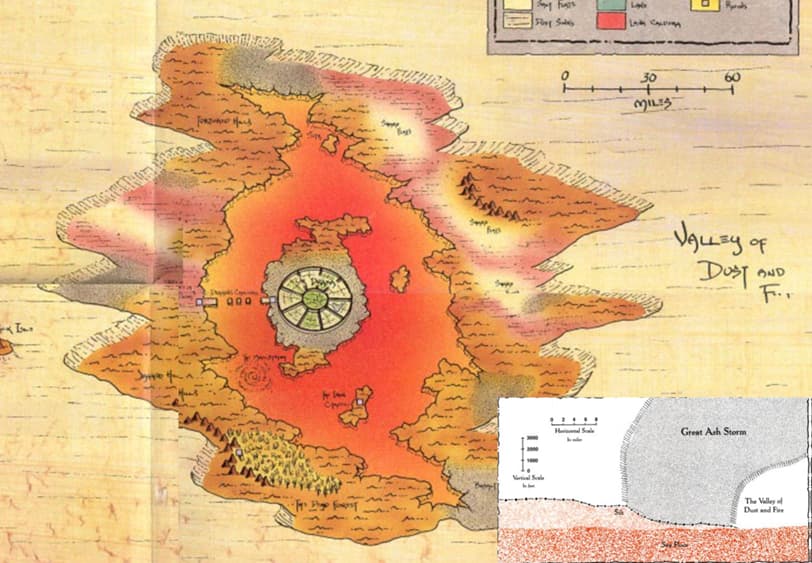
Lets just calculate it using the area in the Valley of Dust and Fire, since we know its size and the depth of the sea surrounding it.
Here are my rough total size estimates based off the maps depicted below:
22,000 square miles at 3000 feet depth. (I removed the area of Ur-Draxa Isle, as it is presumably higher than the 3,000 ft).
We are also not calculating the magma evaporating the water, like how much water need to fall at what rate to cool the magma enough that it solidifies or becomes semi-solid to allow more water on top of it.
EDIT: I used your storm calculations above and estimated that it would take 25 Athasian years to fill the Valley with water at 3,000ft.