The Nature of Elves on Athas - Soul or Spirit?

Prolegomenon. One of the chief challenges inherent to the Dark Sun system is a lack of a coherent and clarified cosmogony, or creation narrative. And though this adds greatly to the mystery, even the DM is left without this arguably essential foundation to the narrative structure of the Athasian universe. Ultimately, though the more experienced of we the Dark Sun fandom may have our insights, we are left without a shared and clear understanding of the gods, the afterlife, and the cosmology as a whole. Without such understandings, this leads to certain significant, even structural, narrative challenges, and to the inquisitive player or thoughtful campaigns, this may prove problematic.

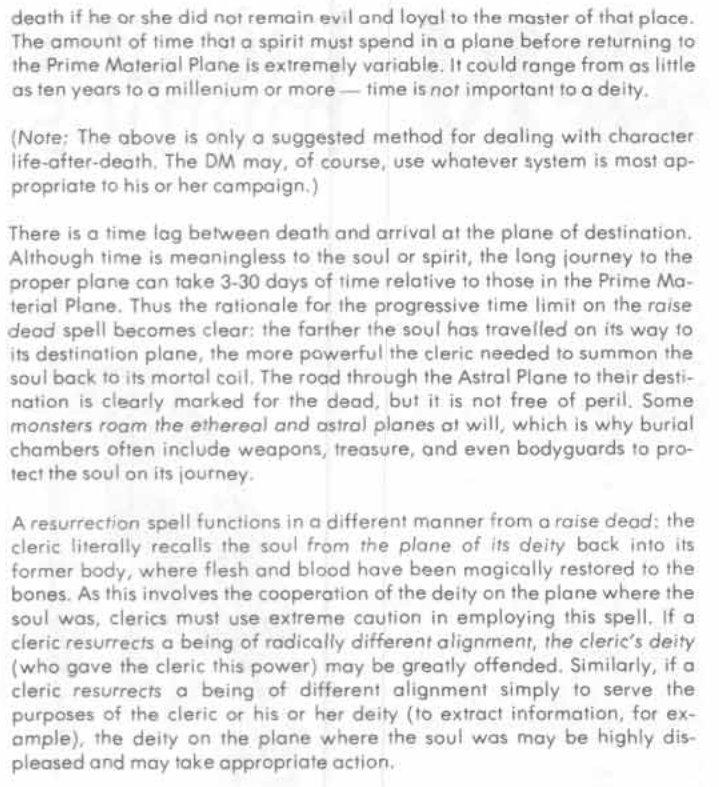
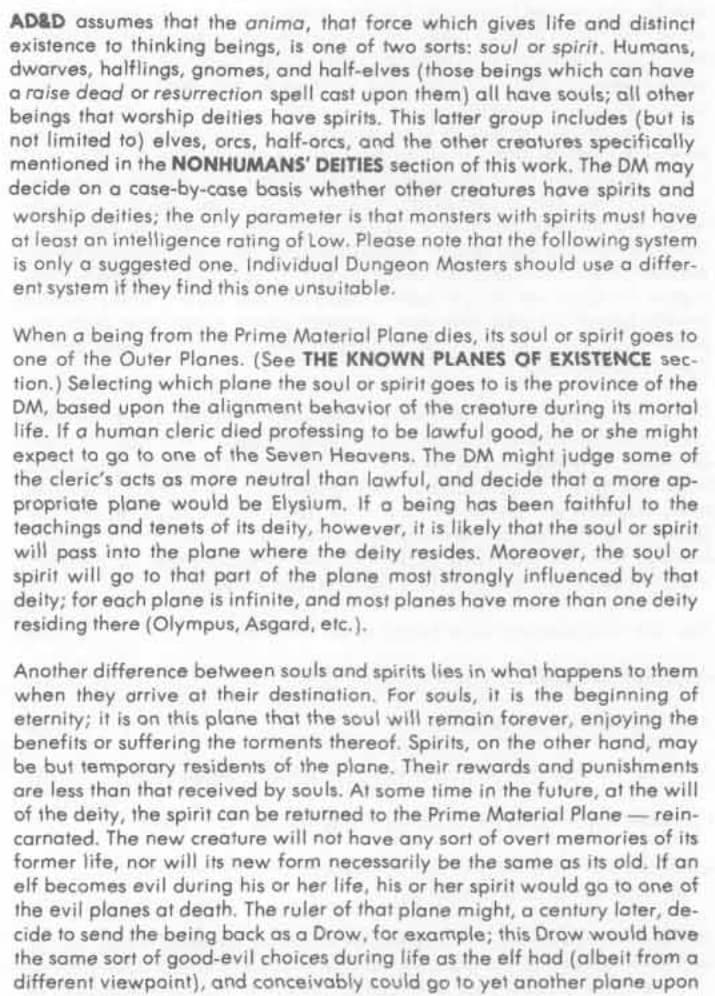
The Issue. An example of this is the nature of elves. In my rather strong opinion, fantasy elves as we have come to know them in the last 100 years have almost totally been dominated by the elf as understand by Tolkien in his Legendarium. For Tolkien, the elves are clearly understood as the first created “Children” of God, and though immortal and possessed of certain other powers and characteristics as opposed to mortal men, their chief difference as I understand it is that the anima or fea of an elf is utterly bound to the created world while it lasts, unable to return to God (i.e. the Outer Planes) until the end of time even if the body dies, whereas Man is accorded the Gift of Iluvatar (death), and allowed to die and escape Creation, presumably reuniting with God or otherwise at least translating to planes beyond prime material space and time. This concept is strongly adopted by AD&D (see the original Legends & Lore, p. 10) where humans and others have souls that take permanently to the Outer Planes upon death, and yet when elves and orcs and the like die, their spirits, as opposed to souls, return only for a little while to the Outer Planes, and then reincarnate upon the Material World after a time of judgment and rejuvenation, much as Tolkien’s elves did upon leaving the Halls of Mandos and reconstituting.

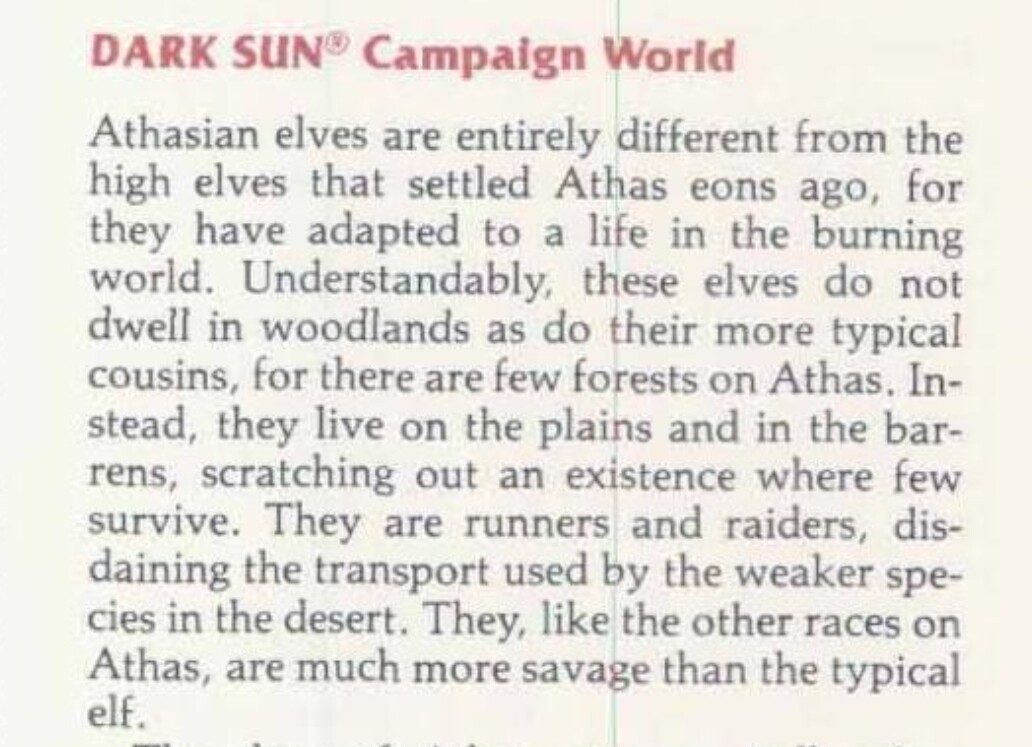
However, in Dark Sun formal publications, I cannot recall a single hint at any difference in soul or spirit between man and elf. Presumably, from all published Dark Sun lore, unlike in all other fantasy AD&D worlds, the elves of Athas have only base biological differences between humans. There are no differences of soul and spirit that we can detect, and therefore elves are merely pointy eared humans, standing a little taller, sprinting a little faster, and a little more hardy and intelligent, but otherwise not terribly distinct from humans.

Now for many, this purely biological distinction between man and elf on Athas is enough, and need go no deeper than that. Indeed, quite arguably the matter is all but fully resolved by Troy Denning’s narrative of the racial metamorphoses in the wake of the defeat of the Brown Tide, in which we understand that all the various humanoid races seem to evolve from the original halfling. Perhaps this simply is the case, and I am being too thoughtful on the matter.

Complication. That said, some complication still arises for me. For the elves of modern Athas seem a twisted version of the classic AD&D variety (famously so!). Instead of capable of living many centuries in a single body, they live truncated lives. Instead of a dimunitive and ethereal (“faerie”) existence, the fallen elves of modern Athas are tall and crass, almost wholly debased from the ennobled high elves of Tolkien, descended from those who have seen the Light of the Divine. I take it that the elves are fallen from an earlier, ennobled nature, or so it is subtly suggested. Surely Simon Hawke’s Tribe of One series indicates that nobler elves once lived on the face of Athas. Did they live longer? Were they shorter? Were they more distinct from humans, apart from some relatively minor biological differences? Or were they simply more culturally different, more in tune with nature or the world as a matter of ethnic preference, and cultural taste?

The Query. These questions I ask. If we had a better Dark Sun cosmogony, a thorough understanding of the Athasian afterlife, perhaps answers to my elven queries would be more forthcoming. I remember the near death experience of Rikus from the Verdant Passage, where it seems he is on the edge of walking through the door to the afterlife, invited by a psychopomp to step through. What would he have experienced if he had? Would there be any difference for an elf or human? I am not certain, but I field these questions, in case the Arena would venture any deeper answers that I do not as yet see.

Cheers to those in the Arena.

PG
So, one problem you can run into is, according to canon, the elves of Athas aren’t “elves”; they aren’t descended from the creations of Corellon Larethian. They’re mutant halflings. They may have shapes reminiscent of the elves of other worlds, but they may not be “elves”, assuming you go with the canon answer.

With regards to longevity, you have the elves of Sylvandretta, in the Last Sea region. They’re noted with “Millennia of inbreeding among these creatures has caused their life spans to be cut to half of the traditional elven length.” Is that half of a non-Athasian elf? Or half of an Athasian elf? The longevity of “elves” might never have existed on Athas.

But, further, I have another suggestion about cosmogony: Whether or not they have souls, or, indeed, any Athasian has souls, is largely immaterial, due to the existence of the Gray. As it stands between the Athasian Prime/Crystal Sphere and the Astral, few to no Athasian souls will reach the Outer Planes, and will instead be mired in the Gray, dissolving there. In some sense, the lack of a soul might be an advantage to the elf, as their spirit may return from its exile in the Gray before it dissolves, but a soul likely would not, without significant magic being involved.

1 Like

The clear message of DS1 was that, indeed, the Athasian races were distorted versions of classic D&D races. The implication seemed to be that whatever unnamed environmental catastrophe had happened in the distant past had caused an evolutionary punctuation, resulting in mass dieoffs and rapid change in the physiology of surviving races.

If we take that implication to be the actual case, then Green Age elves would have been more-or-less identical to standard (2e) D&D elves (this is supported by accounts in the novels of Green Age dwarves being indistinguishable from “standard” dwarves).

Now comes the tricky part. Because each crystal sphere has its own theology, and the Athasian one in particular is, I believe, disconnected from the Great Wheel[1]…anything goes. There’s nothing necessarily to say that, even if Green Age elves looked like traditional D&D elves, they are metaphysically similar.

My personal take on Dark Sun has always been that it was a secular setting…no gods, no alignments (at least as a metaphysical concept), no souls. But that’s not supported anywhere except in my own campaign info.


  1. I…don’t really understand how D&D cosmology works. ↩︎

2 Likes

I don’t think Dark Sun is intended to be separated from the Great Wheel, even before the Gray was a concept. Dragon Kings lays out the usual order of the planes, and seems to jive with that. Defilers and Preservers incorporates the Gray, which was a PP invention (I think).

1 Like

My wonder lays principally with the metaphysical, Calion. What exactly is to be had? What, if any, can be regained, by a modern Athasian? Did an ancient elf once live for centuries, and upon a time return, reincarnated into the world of Athas? Or did even the greatest elf live and die not much different than any human?

I’m unaware of ANY DnD elves (much less orcs) that are clearly described as having this cyclical soul process, so it would seem to me to be a moot point.

The elves of the Realms certainly don’t do this.

Got some references?

1 Like

Right. And that’s the tricky bit. If, again, you take the “marketing picture” of Athas, then the Green Age is simply a standard D&D setting, period. But…what does that entail? I mean, for one, a standard D&D setting has gods, which Athas does not seem to have. So it is already varying from that standard, unless somehow the gods vanished between the Green and Brown Ages…which there is some support for in The Verdant Passage.

I guess that’s the question: Just what happened between the Green and Brown ages? We have a canonical answer, of course, but then we’re back to “all demihumans are just devolved halflings,” and so it doesn’t make any sense that their souls, if they have them, would be any different from other races.

If you abandon that assumption, however (which I for one am happy to do), then we’re left with a crucial question: Where did the gods go? Were they never present? That would seem to argue against elves being metaphysically distinct from other races, as “metaphysics” in the theological sense basically never existed. Did they leave in the distant past, as DS4 suggests? Or did they somehow vanish between the Green and Brown ages? These last two answers would seem to provide more room to make Athasian elves metaphysically distinct from, say, humans. They could, for instance, be creations of Corellon Larethian, and their souls are constantly trying to get back to Him after death.

Or, of course, whatever you want! But these seem like the broad strokes of possible answers to me.

For elven cycles of reincarnation, those are talked about in Complete Elves, but with no actionable rules… like a lot of that book, it’s “Elves are really cool, unlike those plebian creatures.” It was something that was implied in 1e, where they couldn’t be raised, but it wasn’t developed that I know of.

But I don’t think Athas would ever have been a standard campaign world. It might have looked like one from above, but you mentioned the absence of deities. But also, consider, the absence of wizardly magic. No wizards casting spells, building towers, making magic items. Dwarves may have once had beards and lived underground, elves may have lived centuries, but that’s just basing it off suppositions of what such a world might have looked like.

Defiling didn’t get taught until more than a hundred Kings Ages after the Green Age started… 9000 years without magic, compared to there only being 3500 or so after the Green Age… indescribably long periods of time, yes, but “The Green Age looks like a standard D&D world” doesn’t hold up, if we keep Rajaat’s version of history (the official version).

But back to elven souls, and whether or not the exist. If, as Complete Elves says, they’re the descendants of Corellon (via “nomadic high elves”), then they don’t have souls, unless the modern Athasian elf is so heavily mixed with humanity (or other species) that they’ve acquired them over the centuries. If they’re descended from halflings, it would seem likely they do, assuming Athasian halflings do.

You’re mixing things up a bit. I’m explicitly abandoning canon, and speculating what Athas may have looked like solely from DS1+The Verdant Passage, both of which seemed to indicate that the Green Age was more-or-less standard D&D, but of course without many specifics. If we just do canon, as @phaaf_glien notes, elves, like humans, are simply distorted halflings, making it very unlikely that they would have different metaphysical characteristics from any other race.

I would like to note though that dwarves having beards and living underground isn’t a supposition; it’s a definite and canonical part of the history of the setting.

Even abandoning post Verdant Passage, I think the very nature of Athasian magic means that it couldn’t have looked like a standard campaign world; unless defiling is a recent creation, you’re going to have had an ongoing cycle of defilement and restoration. Add in widespread psionics, and the questionable existence of deities, and the Green Age is very different than Dragonlance or the Forgotten Realms.

1 Like

My assumption (never outright stated in DS1, but seemingly implied) was always that it was defiling magic itself which caused the destruction of the ecology, which would imply that it was created in the Green Age.

Deities is a real question, and in some sense the question here. Certainly there are ruined Green Age temples…with present, and active guardians. Did we ever get any explanation of those?

As for psionics, you’re definitely right, though my own headcanon has an explanation for that too…